Busosan Mountain

There are actually a few locations that I'd like to tell you about which are all in the vicinity of Busosan Mountain. So I'll recommend a course which starts at Gudurae Ferry Quay, where you can take the boat, continues through Goransa Temple, Nakwaam Rock, and Busosanseong Fortress. From Busosan Fortress you can continue the walk and head back towards the city, but when I walked this course I wanted to take another boat ride, so I actually did a full loop of all of these sites. This is a great course as it gives you the opportunity to tour some of Buyeo's historically significant sites which were once part of the ancient Kingdom of Baekjae. The Kingdom of Baekjae existed for about 700 years, from its foundation in 18 BCE to its fall in 660 CE, and had a significant influence on the development of city planning, architecture, and art, which were even transferred to neighbouring Japan.
How to get there
By taxi: As previously mentioned on other pages, Buyeo's public transport is pretty limited. The good news is that as a result it's quite easy to get a taxi. From Buyeo Intercity Bus Terminal, you can take a taxi and ride for about 4 minutes which will cost around 4,200 won.
On foot: Another piece of good news is that the city is fairly small so most places are within easy walking distance. So if you'd like to save some money, you can walk from Buyeo Intercity Bus Terminal to the ferry quay, and it will only take about 20 minutes.
Address: Buyeo-eup, Buyeo-gun, Chungcheongnam-do
Gudurae Ferry Quay at Baekma River
If you're not a fan of hiking, this probably isn't the destination for you. However, there is something a little special about Busosan Mountain. Often when we think about climbing a mountain, especially in Korea, we can envisage countless steps and our out-of-breath-selves realising that we seriously need to exercise more often. Well, I'm not about to tell you that there aren't steps because there are, and there are a lot of them, but what makes this a special place to visit is that you don't just have to hike there; instead you can take a boat.
Gudurae Ferry Quay is located on the southern bank of the 16km long Geumgang River (금강). The river was formerly known as Baekmagang (백마강), which literally translates as 'the largest river in the Baekjae Kingdom'. Owned by a private company, the quay runs short boat tours between Gudurae and Goransa Temple. There is a board at the ticket office which sets out the prices, but for reference a one way adult ticket costs 6,000 won and a round trip ticket is 10,000 won. If you follow the course I set out, a one way ticket is probably the best option, however the boat ride was something I wanted to experience fully, so I did get the round trip ticket.
It's referred to as a boat tour, but honestly there isn't much to it. Once on the boat, traditional music is played over the speakers and there is Korean narration which provides some information, but overall the boat ride is very short. So what's so special about it? Well, if you appreciate Korean history you'll be excited to hear that the boat is designed in the style of a traditional Korean boat called, '황포돛배' (Hwangpo Dotbae). Named for it's characteristic yellow sail, the Hwangpo Dotbae was a major form of transportation during the Joseon dynasty. The boats that you take from the quay are modern boats designed in the style of the traditional boat, but it's a fun and unique experience.
You can sit inside the boat and take in the view through the windows, or there is standing space and limited seating at the front and the back of the boat. Wherever you are on the boat you'll see stunning views on both sides of the river, but in particular take a look at the large rock face on your right as this is Nakhwaam Cliff, a historically important feature along this river.

Address: 420 Gugyo-ri, Buyeo-eup, Buyeo-gun, Chungcheongnam-do


Goransa Temple
After a short boat ride, you'll arrive at Goransa Temple Quay. From here you can walk directly up the steps to a ticket office which is in fact not for entry to the temple, but for Nakhwaam Rock. An adult ticket costs 2,000 won. You might even be greeted like I was by a pair of sunbathing cats.
The temple itself is located at the foot of the cliffs of Nakhwaam Rock and offers a stunning view of Geumgang River. There is some uncertainty around when Goransa Temple was established, but there are two legends about its foundation. One legend suggests that it was founded by the monk Hyein under the reign of King Asin (392-405 CE) during the Baekjae dynasty. However, another legend suggests that it was founded much later when King Hyeonjeong (1009-1031 CE) reigned during the Goryeo dynasty. It is said that the temple may have been founded at this time to console the souls of the court ladies who jumped from Nakhwaam Rock when the capital of Baekjae fell to the Silla Kingdom.
These days the temple is predominantly a tourist destination, hence there is a small shop where you can buy souvenirs, traditional Korean snacks or refreshments. There are also opportunities for worship and donations can be made to the temple through various means.
Just behind the temple there is another special site. There is a well named '고란정' (Goranjeong) and it was believed that the water from the spring that fills this well had medicinal properties. It is said that the Kings of Baekjae drank water from this spring at least once a day to maintain their health. There is also a belief that if you drink the water from this well, you will become three years younger. So why not try it for yourself? There are metal ladles near the well so after cleaning the ladle you can dip it into the water and take a sip. I did taste the water and whilst I'm not sure whether I feel any younger, it was very refreshing on a sweltering hot summer's day. It's definitely an interesting and memorable experence that I recommend you try when visiting the temple.


Address: 1, Ssangbuk-ri, Buyeo-eup, Buyeo-gun, Chungcheongnam-do


Nakhwaam Rock
The next location, and perhaps my favourite on the course, is Nakhwaam Rock. Unfortunately you do have to walk up more steps, and they are pretty steep, but once you arrive at the site you'll see why it is all worth it. The name, Nakhwaam (낙화암), means 'rock of the falling flowers'. The meaning behind the name is a metaphor for the court ladies who jumped to their deaths from this rock to avoid capture when the Kingdom of Baekjae fell to the joint forces of the Silla Kingdom and the Chinese Tang Dynasty in 660 CE. The pavilion located at the top of the rock, named Baekhwajeong (백화정), was built more recently, in 1929, to commemorate their martyrdom. The name 'Baekhwajeong' translates as 'white flower pavilion' and comes from a poem that was written by a Chinese poet describing the view of the river from the nearby Busosanseong Fortress.
If you walk past this rock you will be able to see the view of the river from atop the cliff that you passed on the boat. The view is absolutely breath-taking, and for me it is one that I don't think I've seen anywhere else on my travels in Korea. It's from here that you can actually appreciate how large the river is and the beauty of its surroundings. I think I often compare the natural landscape of Korea with that of Europe and usually I see the similarities, but after spending time here I could fully appreciate the unique beauty of Asia's rivers and mountains.

Address: Ssangbuk-ri, Buyeo-eup, Buyeo-gun, Chungcheongnam-do


Busosanseong Fortress
The last site on this course is Busosanseong Fortress which, as you might have guessed, can be found at the top of some more steps. But trust me, after these steps it goes downhill - in a good way! So once you've conquered the steps, you'll follow a path through the forest and reach a clearing where there is a crossroads. This area is known as Baekje Historical Areas, which was in fact designated as a UNESCO World Heritage Site in 2015. It encompasses a large area, including the nearby city of Gongju, and contains several historically significant sites that were once part of the ancient Kingdom of Baekjae.
From this central point you can take a few different hiking trails, including the Taejagol Forest path (태자골 숲길) and the path to Busosanseong Fortress (부소산성). The fortress is a complex of defensive structures that cross a valley between two mountain tops. The fortress has undergone several changes since its foundation in the Baekjae Dynasty, with additions being made after its fall to the Silla Dynasty (a time referred to as the Unified Silla Period), as well as later in the Joseon Dynasty. If you want to know exactly which structures were built in each era, you can follow the dedicated trails as shown on the map at the entrance to the fortress. In summary though, the fortification wall that crosses the valley was constructed during the Baekjae Period and is about 2,496 metres long. During the Unified Silla Period, walls measuring 410 metres high and 1,420 metres long were added which helped to enclose the mountain tops where Sajaru and Banwollu pavilions stand today. Finally, another 760 metre long wall was built during the Joseon Period in order to defend a military storehouse in the area.
I was starting to feel quite tired due to the heat and humidity that day, so I didn't fully explore this area or make it all the way to the fortress gate. However, I did visit two of the pavilions along the fortress trail. The first that I visited was Banwollu Pavilion (반월루), meaning 'pavilion of the half moon' referring to the shape of the river. Sadly the current structure at this site is far from original, having been built in 1972. It is believed that there was once a watchtower at this site but the site fell into ruin some time ago. It is, however, possible to go up inside the pavilion (after removing your shoes!) and it offers a great panoramic view of downtown Buyeo as well as the river.
The other pavilion that I visited was Sajaru Pavilion (사자루). The pavilion was originally used as the main gate of Imcheon local government during the Joseon Period, but it was relocated to Songwoldae Rock (Busosanseong's highest point) in 1919 during the Japanese Colonial Period. During its relocation, a gilt-bronze standing Sakyamuni Buddha triad was discovered and it can be viewed at the Buyeo National Museum. Another significant feature of this pavilion is that the plaque on which its name is written was calligraphed by the fifth son of Korea's last Joseon king, King Gojong.
So that's the recommended course, and as I mentioned, you can continue the route along the fortress and then head back towards the city, or do a loop and go for a second boat ride.


What to eat
After all of that walking you must be hungry and thirsty; I know I was. Fortunately, the street leading to the quay is lined with multiple restaurants and cafés, so there's plenty to choose from. Here are two restaurants and a café I visited during my stay in Buyeo which I can highly recommend as the food is both traditional and delicious.
After the hike I wanted something cool to eat so I decided to visit a restaurant close to the quay, called Jangwon Makguksu (장원막국수).
If you were wondering, Makguksu is basically buckwheat noodles served in a cold broth and it's the perfect menu for a hot summer's day. Perhaps it was for this reason that there was a long line of people waiting to eat here! I visited around 2pm for a late lunch but even then the restaurant was filled with diners. As you can see from the photos above, the restaurant is rather different to what we're used to. It seems to be a collection of container buildings with a partially open kitchen. The line actually moved much quicker than I expected and when you reach the counter and order your meal, you'll be directed to a table. This is a traditional restaurant so you will be asked to take your shoes off and sit on the floor when eating. There are only two items on the menu; Makguksu and sliced pork (편육). The Makguksu only costs 8,000 won and the sliced pork costs 21,000 won. I think both menu items are very reasonably priced as it's rare to find a meal under 10,000 won these days in Korea, and the plate of pork is actually pretty large. Because I visited alone, I only ordered the Makguksu but the staff member recommended that I also try the pork, so they gave me half a serving at half price. As you can see in the picture below, it was still a large portion!
The dishes are also served with a small assortment of side dishes, known as banchan (반찬) and include two kinds of Kimchi, anchovies, garlic, peppers and Ssamjang (쌈장). Practically all Korean restaurants provide a bottle of water free of charge, but this restaurant offers a cup of tea which I think was barley or buckwheat. It's very mild and a little sour, but pairs well with the dishes. Once you've finished your meal, staff very quickly clear the table and you take your order receipt back to the counter to pay.
The meal was really delicious and refreshing, and the combination of Makguksu and sliced pork is great. If you're like me and can't tolerate too much spice, you don't have to worry about that red paste hiding under the cucumber. Once mixed together, the spice is offset by the tangy, cold broth, and even the Kimchi wasn't too spicy especially if eaten with the pork.
So if you're looking for something cool and refreshing after your hike, it's worth the wait to try Makguksu at Jangwon Makguksu.
The other restaurant I visited near the quay, not in the same day though, was Gudeurae Leaf Wraps & Hot Pot Rice (구드래 돌쌈밥). This restaurant serves traditional Korean food, including the lotus leaf wrapped rice which is a very special dish, considered a luxury when served at Buddhist temples.
One piece of advice is that you need to be seriously hungry when visiting this restaurant, especially if you're alone. All of the menu items state that the portion size is for one person, and you can request a larger portion size if there are a group of you. Honestly, for me the amount of food was a little too much so I felt a little pressure to eat more so that it wouldn't be wasted. Another thing to bear in mind is that the menu items are all rather similar. I think the side dishes don't really change, but the type of meat and the way that the rice is served will change.
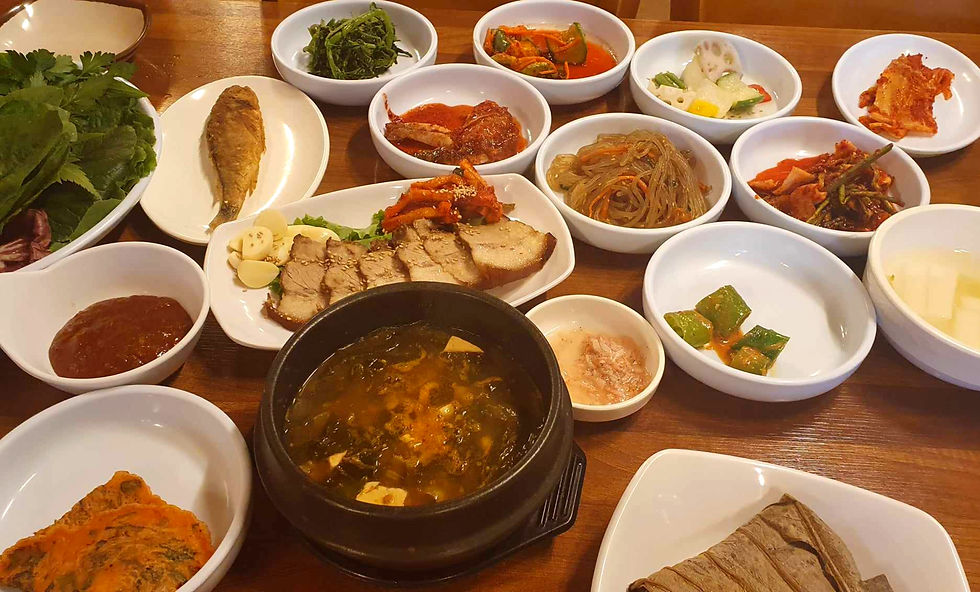
I ordered the 주물럭연잎밥 (jumulreokyeonipbap) for 22,000 won. You can see in the picture below that this included several side dishes, a soup, pork slices, lettuce and rice wrapped in a lotus leaf. I was really excited about trying the lotus leaf wrapped rice (which I now realise is barely visible in the photo - sorry!) as this is both a healthy and visually pleasing dish. A mixture of sticky rice, millet, gingko nuts, jujubes and even chopped, boiled lotus roots are placed in the centre of a lotus leaf. As it gets hotter, the steam causes the lotus leaf to roll up and cover the rice. When it's ready, you peel off the lotus leaf to reveal the sticky rice which can be eaten once it's cooled. The rice gives off an aromatic scent and the taste has some floral notes. It's definitely something I recommend you try at least once while you're in Korea.
Now for something sweet! Next to the restaurant mentioned above, there is a café called, Café Buyeoyu (카페부여유). The interior is modern but traditional in a way. It has a really welcoming and cosy vibe with a variety of seating options. The menu offers a variety of drinks and desserts but I decided to try their 'best' menu item which is the 'ICE 부여유라떼' (Ice Buyeoyu Latte). So the menu confused me a little at first as it said the ingredients were '마' (horse), '연근' (lotus root) and '꿀' (honey). Before you freak out about the 'horse' part let me explain. So throughout your stay in Buyeo you'll come across many mentions of Baekjae's King Mu, who was referred to as Seodong when he was young. So the menu explains that the 'horse' ingredient is actually a reference to Seodong making a living from selling horses when he was a boy. That's it - no other 'horse' included in the drink. So the latte is basically made from lotus root and honey blended together, and it was quite mild and delicious.
I hope that you too have the chance to experience the culture, history and food of Buyeo's hidden gem, Busosan Mountain.


Address: 8-1, Gugyo-ri, Buyeo-eup, Buyeo-gun, Chungcheongnam-do


Address: 96-2, Gua-ri, Buyeo-eup, Buyeo-gun, Chungcheongnam-do